

Where do we go when we die? Hades
The writers of the New Testament understood that, after death, people either go to Paradise or to Hades.
Here we look at Hades in the words of Jesus and the Bible writers. A shorter version is in Fresh Bible Answers, Christian Understanding, What do Christians Believe? Where did Jesus go when he died? Extra week: Hades,
Hades the holding place where Jesus has been
Jesus was given to people on earth and in Hades
People in Hades can hear Jesus
Jesus proclaimed his mission to release people from Hades
Forgiveness can be given in this life and in the next
The gates of Hades will not prevail against the Church of Jesus.
What do we learn from the New Testament?
The new light of Jesus shines in Hades
Knees can bend to Jesus in Hades
Jesus the Lamb, and his angels, are with people in Hades.
What do we learn from the Old Testament?
God is present with people in Sheol
People can have a hope of not staying in Hades
Consequences of the surprising truth of Hades
Hope which has not been seen before
Prayer and passing on messages
Recovering the Harrowing of Hades
What do we learn from Jesus?
Hades the holding place where Jesus has been
50 days after Jesus died and was raised, Peter, the leader of Jesus’ followers, talked to a crowd. This is part of what Peter said:
God raised him up, having freed him from death, because it was impossible for him to be held in its power. For David says concerning him,
“I saw the Lord always before me,
for he is at my right hand so that I will not be shaken;
therefore my heart was glad, and my tongue rejoiced;
moreover, my flesh will live in hope.
For you will not abandon my soul to Hades,
or let your Holy One experience corruption.
You have made known to me the ways of life;
you will make me full of gladness with your presence.”
Acts 2:24-28
Peter said that God freed Jesus from death. Death had imprisoned Jesus, God freed him. Death tried to hold Jesus in its power but could not hold him. Death has the power of holding, imprisoning people. When people die, they are held, imprisoned, by death. Death tried to do this to Jesus and failed.
Peter went on to quote Psalm 16 in the Old Testament. The Psalm writer, probably King David, looked forward to his soul not being abandoned in Hades. Peter said that this applies to Jesus. The writer of Psalm 16 was looking forward to Jesus. Peter said that Jesus’ soul was not abandoned to Hades.
Hades is the holding place of death. Death holds, imprisons, people and the place where people are held, imprisoned, is called Hades. Jesus went to Hades when he died, but Hades could not hold him as it holds other people
In the Old Testament Hebrew of Psalm 16, Hades is called Sheol.
Therefore my heart is glad, and my soul rejoices;
my body also rests secure.
For you do not give me up to Sheol,
or let your faithful one see the Pit.
Psalm 16:9,10
Hades and Sheol are two different names, in two different languages, for the same place. The Pit is also another way of speaking of the same place for, in Hebrew poetry, the thought, rather than the final sound, is repeated in the following line.
When Peter spoke in Jerusalem, he probably dd not speak Greek but Aramaic, close to Hebrew. He probably used the word Sheol. When Luke wrote, in Greek, he used the word Hades to denote Sheol. He was not thinking of the Hades of Greek mythology. He was not conveying that Jesus had been to the Greek underworld known by the Greeks as Hades. Luke knew that Jesus had been to Sheol and he used a name already familiar to Greek readers to denote the Old Testament Sheol. We, too, do not understand Hades here to be the underworld of Greek mythology but the Sheol of the Old Testament.
Philip S. Johnston, in his book Shades of Sheol: Death and Afterlife in the Old Testament (Apollos IVP 2002), explores in detail what the Old Testament conveys about Sheol and summarises:
‘While Sheol is the most common term, it occurs only infrequently. So, the underworld was not a particularly important concept for the Israelite writers… Descriptive details are very sparse, but suggest a somnolent, gloomy existence without meaningful activity or social distinction… There is certainly no elaborate journey through the gates or stages of the underworld, in Mesopotamian or Egyptian style.
Indeed, in the majority of instances Sheol is used to describe human fate. Sometimes this is a destiny which the righteous wish to avoid, or which in desperate circumstances they see as divine punishment on themselves. More often it is a destiny wished on the ungodly. The occasional synonyms of Sheol portray the same picture. So, the underworld in Israel’s canonical literature can be summarized as an infrequent theme and an unwelcome fate.’ (p85)
The people of Israel were unusual in knowing no detail of life beyond death, having no after-life myths, and not burying their dead with supplies for their next life. They seemed to look at a body buried in the ground or a cave and saw little else. They understood that beyond death was another life, or existence, but saw very little. They had no desire to know more. Philip Johnston wrote:
‘The underworld truly was a place of little interest to the Hebrew writers. They praised and feared Yahweh in this life and this life alone, and had little interest in the world below.’ (p124)
The people of Israel were also unusual in thinking that Sheol was the one place beyond death for everyone. Rich or poor, righteous or unrighteous, all went to Sheol. As Johnston wrote, Sheol was ‘human fate,’ for everyone.
With Jesus, and after Jesus, people began to understand more about Sheol / Hades. Peter talked of Sheol / Hades as the holding place for people generally, which could not hold Jesus. He proclaimed that something unprecedented had happened – a human had been in Sheol / Hades and had come out again. When Jesus’ body walked out of his tomb in Jerusalem his soul was also walking out of Sheol / Hades.
Affliction in Hades
Jesus talked of Sheol / Hades in the parable of the Rich Man and Lazarus:
The rich man also died and was buried. In Hades, where he was being tormented, he looked up and saw Abraham far away with Lazarus by his side. He called out, “Father Abraham, have mercy on me, and send Lazarus to dip the tip of his finger in water and cool my tongue; for I am in agony in these flames.”
Luke 16:22-24
Some translations notably the old King James Version, convey that the rich man was in Hell rather than Hades, but the Greek is clearly Hades, the same holding place as Sheol in the Old Testament.
The most striking element in what Jesus said about Sheol / Hades is the deep distress of the man there. In the parable, Jesus states that the Rich Man is ‘being tormented’ in Hades. The Greek word translated ‘torment’ is basanos. Elsewhere in the Gospels the same word is translated as ‘afflicted’ with diseases and pains (Mth. 4:24), ‘in distress’ from paralysis (Mth. 8:6), ‘battered’ by waves, ‘straining at oars against an adverse wind’ (Mth. 14:24 & Mark 6:48.) Of the range of seriousness that this Greek word can convey, ‘torment’ is at one extreme. A less extreme translation, which still conveys the sense of experiencing a powerful distressing effect (of fire, sickness, waves), is ‘affliction.’
The affliction of the Rich Man in Hades is severe thirst caused by intense heat, and the sight of Abraham far away, alongside the beggar whom he had spent his life ignoring. The Rich Man had spent his life in great physical comfort; his callousness has ensured that in Hades he experiences great discomfort. He feels, experiences, pain and is able to think and talk in Hades.
Some, particularly Protestant, Christians have taught that in Hades, people are in ‘soul sleep,’ – they are in a long coma, not aware of anything. This is very difficult to reconcile with Jesus’ words about Hades. The response to this criticism of their teaching is often that, because Jesus is here speaking in a parable about caring for the poor, he never intended to give information about Hades. Yet Jesus certainly gave the impression that he was giving information about Hades, through using that name specifically.
In his parables Jesus always talked of real-life places, such as the road from Jerusalem to Jericho and the home of a man with 2 sons. We have no reason to suppose he intended us not to think of Hades as a real place beyond this life. Jesus also connected urging people to be generous to the poor in this life with being rewarded beyond this life. Here he specifies the place beyond this life: Sheol / Hades.[1]
Martin Luther was the first teacher of ‘soul sleep.’ He contended that the Catholic practice of asking for money for priests to pray for the souls of those who had died was so abhorrent that every part of it must be wrong. He argued that no priest had any influence beyond the grave. He exaggerated the Old Testament teaching of the ‘somnolence,’ sleepiness, of Sheol arguing no-one beyond the grave was able to respond to anything, for they were in ‘soul sleep.’ Despite this teaching being opposed to Jesus’ teaching, some people continue to assert that, beyond this life, people are in ‘soul sleep.’
In Luke 13:28 Jesus gives the same message as in the parable: ‘There will be weeping and gnashing of teeth when you see Abraham and Isaac and Jacob and all the prophets in the kingdom of God, and you yourselves thrown out.’
Jesus was issuing a clear warning of a real fate beyond death, a living nightmare.
Elsewhere Jesus speaks of the same ‘weeping and wailing and gnashing of teeth’ by people in ‘the outer darkness.’ This darkness is therefore in Hades or part of Hades. Jesus speaking of the outer darkness of Hades implies that there is also an inner darkness, maybe also a middle darkness. We can understand that, in the parable, Abraham, with Lazarus the beggar, is in a different, distant part of Sheol / Hades, for the Old Testament understanding is that Sheol / Hades is for everyone, with no exceptions. Abraham was therefore in the inner darkness, a cooler, watered, place of more restful sleepiness.
Some people have wondered if Abraham was in Paradise rather than in another part of Hades, particularly because, in the parable, Abraham says that there is a great chasm fixed between where he is and where the rich man is. Yet a chasm separates two places at the same level. It makes a horizontal separation rather than a vertical separation. The place where the rich man was and the place where Abraham was were on the same level. Abraham was at a distance from the rich man but not above him. Paradise, according to Paul, is the third heaven. (2 Corinthians 12:2-4) Paradise was thought to be a considerable distance above the earth, with Sheol / Hades below the earth. Paradise is beyond human contact. The rich man in Hades was able to communicate with Abraham. This means that he was in a separate part of Hades.
The UK prison system is known as the Prison Estate. Within this Estate are different prisons, known as Establishments. Life in some prisons, is more restricted, more difficult, than in others. Great divides separate the Prison Establishments within the one Prison Estate. Prisoners in different prisons cannot visit each other. They can, however, communicate, under supervision, by letter and telephone. Hades may well be something like this: a large Estate, with different, separate Establishments.
Jesus took the Old Testament understanding of Sheol, the place of the dead about which little is known, and added to that understanding, showing that it contains miserable affliction. Jesus was probably talking particularly about the deepest darkest parts of Hades.
People in Old Testament times could see into Hades a little, into the inner darkness which is a sleepy half-life. Jesus could see more. Jesus saw and talked about the more comfortable place where Abraham was, the inner darkness. Jesus also saw more and talked about the painful place where the rich man was, the outer darkness. It is clear that, especially for all who listen to Jesus, Hades is a place to be avoided.
Hades: Souls without bodies.
Jesus also spoke of life after death: ‘Do not fear him who can kill the body and not the soul. Fear him who can destroy body and soul in Gehenna.’
Matthew 10:28
Jesus taught that the death we know and experience now involves our bodies being killed and our souls remaining alive. Jesus also taught that there is another destruction of both body and soul in the place which he called Gehenna.
Many translations convey that the destruction of body and soul happens in ‘Hell.’ In the Greek, the place is clearly called Gehenna. For many years, up until today some, translators use the same word, Hell, to translate both Hades and Gehenna. They, along with most Church teachers, assume that Hades and Gehenna are the same place, and that, therefore, they should use the same name in English. There is no evidence that Jesus used two different names for the same place. Rather Jesus’ use of two different names indicates he was thinking of two different places. What Jesus said about Hades is also different from what he said about Gehenna.
The rich man in Hades was feeling, thinking, speaking, imploring. He was clearly alive. He had not been destroyed, nor is there any implication that he was in a process of slow destruction. The Hades described by Jesus is very different to the Gehenna described by Jesus. It is wrong to assume they are the same place and give them the same English name. It is wrong to think and teach that there is one place beyond death called Hell, when Jesus said there are two places beyond death called Hades and Gehenna. Hell as the Church has taught is an unwarranted combination of Hades and Gehenna. We need to return to Jesus’ language and speak, think, teach, not of Hell but of Hades and Gehenna.
When Jesus spoke of Gehenna as the place where body and soul are destroyed, he first spoke of a death which kills the body and not the soul. This life, of the soul apart from the body, is also beyond death, but comes before Gehenna. The life of the soul apart from the body is immediately after death. The destruction of body and soul is beyond this soul life. Sheol / Hades, the holding place, is immediately after death. Therefore, life in Hades is the life of the soul apart from the body – a feeling, thinking, speaking, imploring soul as the soul of the rich man in Hades, not in a long soul-sleep coma.
Many Jews at the time understood that there are two stages of life after death. The first stage is before the coming of the Messiah, the Great Jewish King who will judge humankind and begin a new age, a new cosmos. The second stage is after the coming of the Messiah, the life of the new age. Christians see Jesus as this Great Jewish King who has come to start the judgement and the new life and will come again to complete the new life for all. When Jesus returns, the first stage of life after death will be over. The second stage will begin.
Hades is for the first stage after death, the stage in which the body is dead and the soul is alive. Souls live in Hades without bodies.
Jews at the time also understood, as the Old Testament teaches, that the ultimate fate of wicked people will be their destruction. People who are unwilling to admit the damage they have done to others and to themselves will be destroyed. We believe and trust that these people will be few, compared to the many who enjoy the new age, the new cosmos.
The book of Revelation confirms this understanding of the words of Jesus:
Then I saw a great white throne and the one who sat on it; the earth and the heaven fled from his presence, and no place was found for them. And I saw the dead, great and small, standing before the throne, and books were opened. Also another book was opened, the book of life. And the dead were judged according to their works, as recorded in the books. And the sea gave up the dead that were in it, Death and Hades gave up the dead that were in them, and all were judged according to what they had done. 14 Then Death and Hades were thrown into the lake of fire. This is the second death, the lake of fire; and anyone whose name was not found written in the book of life was thrown into the lake of fire.
Revelation 20:11-15
Here we are shown the Final Judgement by Jesus. We see that Hades, the holding place, gives up all the people held in it. Hades is then thrown into the lake of fire. Hades has completed its purpose of holding people – for the Final Judgement. We see why people are held in Hades – to wait for Judgement. We know a place where people are held while they wait for judgement, for a court hearing, as a remand prison. Hades is the remand prison, or Prison Estate, before Final Judgement.
Hades is then incinerated in the lake of fire. This lake of fire is also called the second death, the same fate as the destruction of body and soul. The lake of fire is also known as Gehenna. Eventually, Hades will be emptied and thrown into Gehenna. Hades and Gehenna cannot be the same place.
Immediately after death, said Jesus, our body is dead, but our soul is alive. When Jesus comes again, everything changes. Then both soul and body live in a New Creation with no more death, with some people having been destroyed, body and soul, in Gehenna.
We are used to thinking that life immediately after death is the life that is the same forever, that there is only one stage of life beyond death. We have been taught that life immediately after death is eternal life. The Church has, mostly, taught this for centuries, although it is a Greek understanding rather than a Jewish, Biblical, understanding.
We find it hard to take in that Jesus and the Bible talk of two stages beyond this life, not one. Tom Wright, Bishop and Theologian, has demonstrated in his book ‘Surprised by Hope’ that we are to believe not only in life beyond death but also in life beyond life beyond death.[2] Hades is life beyond death. Gehenna is the destruction of human life beyond life after death.
Jesus has the keys of Hades
‘Do not be afraid; I am the first and the last, and the living one. I was dead, and see, I am alive for ever and ever; and I have the keys of Death and of Hades.’
Revelation 1:17,18
These are Jesus’ words. He is speaking to John, the writer of Revelation, in a vision after his resurrection and ascension. Christians count these words as the words of Jesus, rather than the words of John, and, therefore, they are part of the foundation and cornerstone for our understanding, which is Jesus.
These are words we need to listen to first, as foundation, and to put in place first, lining other words up with them, as cornerstone. (Think of beginning a jigsaw with the corner pieces and lining other pieces up with them.) For no one can lay any foundation other than the one that has been laid; that foundation is Jesus Christ. (1 Corinthians 23:11)
Yet these words have been the most ignored words of Jesus, throughout history. They are like the stone which the builders rejected. They are odd words, in an odd book, pushed to one side as irrelevant to building our understanding, especially of Hades. What happens when we take these words seriously as words of Jesus himself, think about them carefully, as primary to our understanding?
Jesus here confirms what Peter has said, as recorded in Acts 2: He was dead, He is now alive. He has been in the place, the realm, of the dead, and now he has come out. Death and Hades are connected, the keys to one are the keys to the other. Hades is a place where Jesus has been, as Peter explained at Pentecost. To this is added a striking new insight: Jesus now holds the keys of Hades.
Jesus has the keys of Hades. Jesus has the authority and the ability to open the doors of Hades. Jesus can unlock the doors, and the chains, he chooses to open, lock the doors and chains he chooses to shut, and do this whenever he chooses. Jesus has the authority and ability to go in and out of Hades. The way which Jesus took out of Hades is not now closed behind him. It is open whenever he wants it open.
Jesus says that He has THE KEYS of Death and Hades. He does not say that he has some keys, those related to certain people or groups of people. Jesus has THE keys, all the keys. There are no keys which are not now in Jesus’ hands. There is no single person locked in Hades to whom Jesus does not have the key.
The simple surface meaning of someone having the keys to a place is that they control access to and from that place. We know what it means to have bought or rented a new flat or house and then to be given the keys. Once we have the keys can we go in and out whenever we choose with whoever we choose. Jesus, alive for ever, can go in and out of Hades, whenever he chooses, with whoever he chooses. He holds the keys in his hands permanently. He can use these keys at any time. This is part of our doctrinal foundation and cornerstone.
Some people say that Jesus having the keys of Hades means that he has a more general control of Hades. But Jesus did not say ‘I have authority over Hades, or authority in Hades.’ He said he has the keys of Hades. As Prison Chaplain, I have had access to the keys of the prisons where I have worked. I have not been in control of the prisons. Other people are in charge of the prison. I can go in and out, taking visitors in and out with me. Jesus has the keys of Hades, not, yet, control over everything that happens in Hades. We respect the words that Jesus chose to use and to have recorded and build our understanding on his exact words.
Jesus’ assertion is not that He ‘has had’ the keys of Hades. A universalist interpretation would be that Jesus has opened Hades so completely that everyone is now free to leave without any further intervention on the part of Jesus. In such a scenario Jesus would have no further use for his keys. He would not continue to hold them. Jesus saying that he has the keys implies, rather, that he has not finished using them. Jesus has complete access to anyone in Hades but this does not mean that Hades is already empty or redundant. Hades continues in existence and people continue to be imprisoned in Hades until Jesus’ Father decides that the time for Judgement has come. All people in Hades have the potential to be released, saved, by Jesus, but for this they need the specific intervention of the key holder.
The question then arises: Does Jesus choose to return to Hades? He did not say specifically what he does with the keys. Jesus did not say ‘I now go in and out of Hades whenever I want, bringing with me whoever I want.’ He leaves that for us, with the Holy Spirit, to work out. Maybe Jesus chooses not to re-enter Hades, saving only those whom He has chosen to save in this life. This is the traditional understanding of conservative Christians, both Protestant and Catholic.
Jesus in Hades is still ‘Jesus’, ‘Yeshua’ in his original Aramaic language. ‘Yeshua’ means ‘God saving.’ Jesus is and always will be God Saving. Jesus in Hades could not stop being Jesus, being the Saviour, for that is his name and his nature. Jesus’ presence in Hades must have been a saving presence, not a condemning presence. Jesus Christ is the same yesterday and today and for ever. (Hebrews 13:8) For the Son of Man came to seek out and to save the lost. (Luke 19:10) Jesus tells us that he now has the ability to go in and out of Hades whenever he wants.
If Jesus chooses not to use His keys, why did he proclaim and have recorded in Scripture that he has the keys of Hades? It could be that Jesus has the keys but they hang on his wall in Paradise unused. But this is completely inconsistent with the name and nature of Jesus. If Jesus does not use the keys of Hades, the only reason He would tell the world is to impress people with his power and his hard-heartedness. Again, this is so uncharacteristic of Jesus to be impossible. If, on the other hand, Jesus does use his keys, to save people in Hades, this is a wonderful, heartening, continuation and extension of the Good News. Christians, surely, who know the loving, saving, Jesus are compelled to conclude that Jesus announces that he has the keys because he has every intention of using them whenever he can.
Jesus uses His keys of Hades to continue to seek and save the lost. He continues to seek in humility. He comes to his own people, and to all people, as one who can be, and is, rejected. But to those who receive him, who believe in his name, he gives power to become saved children of God. (John 1:11,12) Jesus came to people on earth and continues, through his Spirit and through his Church, to come to people on earth. Jesus, the key holder of Hades, also comes to people in the life beyond death and before the Final Judgement. And these people are not in a ‘soul-sleep’ coma. What would be the point of Jesus coming to souls fast asleep, or even having the ability to come to these souls? Jesus can and does come to people in Hades who are able to respond to him.
I have talked with several people, not Christians, and quoted to them Revelation 1:17,18. ‘Oh!’ they say with surprise, ‘So Jesus can get people out of Hades.’ People first hearing these verses draw the obvious conclusion. Examining the text more closely leads to the same conclusion. Yet it is a conclusion that the Church has so far avoided, by ignoring Revelation 1:17,18.
Jesus was given to people on earth and in Hades.
For God so loved the cosmos that he gave his only Son, so that everyone who believes in him may not perish but may have eternal life.
Indeed, God did not send the Son into the cosmos to condemn the cosmos, but in order that the cosmos might be saved through him.
John 3:16,17
We are used to these words of Jesus being ‘For God so loved the world…’ The Greek word here is, literally, cosmos. God gave his Son to the whole cosmos.
John was writing mostly to Jewish people who spoke Greek, the common language of the day. John was writing from a Jewish understanding of the cosmos to people with a Jewish understanding of the cosmos. Here is a diagram, from Biblical cosmology – Wikipedia of the cosmos as Jews understood it:
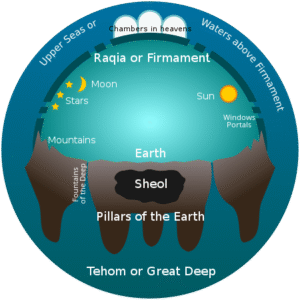
The top, light blue half, are the heavens, the skies. The brown is the earth, with people alive on the earth. The black is Sheol / Hades, in or under the earth. The cosmos is the heavens, the earth and under the earth. The cosmos includes Sheol / Hades.
Jesus in John 3:16 says that whoever in the cosmos, whoever on the earth and whoever under the earth, who believes in him shall have eternal life. John 3:16 has been taken as giving hope for eternal life across the whole surface of earth, for people of all tongues and tribes and nations. John 3:16 also gives hope for eternal life throughout Hades, for people of all tongues and tribes and nations. Jesus uses his keys of Hades to seek and save the lost because this is an important part of why God sent him to us.
It is good to recognise other places where John or Jesus writes about the cosmos:
He was in the cosmos, and the cosmos came into being through him; yet the cosmos did not know him. He came to what was his own, and his own people did not accept him. But to all who received him, who believed in his name, he gave power to become children of God, who were born, not of blood or of the will of the flesh or of the will of man, but of God.
John 1:10-13
The power to become children of God is given to people throughout the cosmos, including to people in Hades. All in Hades, who receive Jesus coming to them, as he uses his keys, can be born of God.
People in Hades can hear Jesus
Very truly I tell you, whoever hears my word and believes him who sent me has eternal life and will not be judged but has crossed over from death to life. Very truly I tell you, a time is coming and has now come when the dead will hear the voice of the Son of God and those who hear will live. For as the Father has life in himself, so he has granted the Son also to have life in himself.
John 5:24-26
Jesus here speaks in a way similar to John 3:16. Whoever hears Jesus, like whoever believes in Jesus, has life, has moved from death to life. Jesus goes on to say that this means or includes the dead hearing his voice and then living. Jesus can speak to the dead – to those in this life who are heading for death and to those already dead. As Jesus was speaking this was already true in some way and would be more true in the time that was then coming.
Jesus went on to speak to Lazarus when he was dead, telling him to come out. (John 11:43) Lazarus heard Jesus and came out. Hearing in Hebrew / Aramaic means not only registering sounds with our ears, but acting according to those sounds. We might talk of someone hearing fully, taking in and acting on what they have heard. Lazarus acted according to the voice telling him to come out. Jesus spoke of the dead, now in their graves, hearing his voice and being given life. Jesus then demonstrated a dead man, in his grave, hearing his voice and being given life.
The time that was coming was the time beyond Jesus death, the time when he went to Hades. There is an echo here of Jesus talking of his death: The days will come when the bridegroom is taken away from them… (Mark 2:20) Because Jesus was then with people in Hades they could hear him more. Because Jesus now has the keys of Hades he can continue to be with people in Hades, and they can continue to hear him, They can hear Jesus as the thief dying next to Jesus heard him. Jesus was and is life among the dead, giving life to the dead, as granted by God.
Jesus continues. He explains that the dead who hear his voice are not only those in Hades but also those who come to the Judgement.
And he has given him authority to judge because he is the Son of Man. Do not be amazed at this, for a time is coming when all who are in their graves will hear his voice and come out—those who have done what is good will rise to live, and those who have done what is evil will rise to be condemned. By myself I can do nothing; I judge only as I hear, and my judgment is just, for I seek not to please myself but him who sent me.
John 5:27-30
Another time is coming – Judgement time. This is time when all in their graves, in Hades, will hear Jesus and all will come out, the time described in Revelation 20:11-15 as quoted earlier. At this time, too, the dead will hear Jesus, as their judge.
As when he talks of eternal life, Jesus talks of people hearing him in 3 stages, in this life, in Hades between death and Final Judgement, and at the Final Judgement itself. Often these words have been understood to refer only to 2 stages, in this life and at the Judgement. A close examination shows also that people hear the voice of Jesus when they are dead, in the grave, in Hades. Those who fully hear are given life.
Peter also affirms this truth and gives us the reason:
For this is the reason the gospel was proclaimed even to the dead, so that, though they had been judged in the flesh as everyone is judged, they might live in the spirit as God does.
1 Peter 4:6
The gospel is the message of Jesus: The kingdom of God has come near. Repent and believe the good news! (Mark 1:15) This gospel was proclaimed even to the dead. The dead in Hades / Sheol are sharing the fate, the judgement, of everyone. They have sinned and have not sought and found the forgiveness of Jesus. The gospel was preached even to these people, that they might live in the spirit, that their souls might move to Paradise instead of Hades. Earlier Peter specifically mentions Jesus preaching to the generations before the flood. Here he widens it to simply ‘the dead,’ ‘everyone’ who has sinned.
(The NIV translation reads ‘the gospel was preached to those who are now dead.’ The word ‘now’ is in no Greek manuscripts. It has been inserted into the original text by the translators.)
Peter was writing about the sinners of this life, living in licentiousness, passions, drunkenness, revels, carousing, and lawless idolatry. 1 Peter 4:3. They will have to give an account to him who stands ready to judge the living and the dead. 1 Peter 4:5 these sinners need to hear the message of the forgiveness of the Kingdom of God before they are judged. They did hear it, affirms Peter.
Peter is almost certainly thinking of the time when Jesus was in Hades between his death and resurrection. When he was writing, he thought back to this time and wrote that the gospel was preached. He does not explain this in detail, probably because he assumes that they would already know that the gospel was preached by Jesus when he was in Hades. He writes of this as something not at all new to people reading his letter.
We can put what Peter, and probably his readers knew, together with Jesus continuing to have the keys of Hades and with Jesus speaking of the dead, generally, hearing him and being given life, and conclude that the dead did not only hear the life-giving gospel from Jesus when he was in Hades between his death and resurrection, but also hear the same life-giving gospel whenever Jesus is able to come to them.
Jesus proclaimed his mission to release people from Hades
When he came to Nazareth, where he had been brought up, he went to the synagogue on the sabbath day, as was his custom. He stood up to read, and the scroll of the prophet Isaiah was given to him. He unrolled the scroll and found the place where it was written:
‘The Spirit of the Lord is upon me,
because he has anointed me
to bring good news to the poor.
He has sent me to proclaim release to the captives
and recovery of sight to the blind,
to let the oppressed go free,
19 to proclaim the year of the Lord’s favour.’
And he rolled up the scroll, gave it back to the attendant, and sat down. The eyes of all in the synagogue were fixed on him. Then he began to say to them, ‘Today this scripture has been fulfilled in your hearing.
Luke 4:16-21
Jesus saw himself as the anointed one of God who was beginning to set people free and bring comfort and gladness to those who mourn. Luke gives these words particular importance by recording them as Jesus’ first, keynote proclamation, instead of The Kingdom of God is near, Repent and believe the Good News, recorded by Mark and Matthew. Probably Jesus gave both messages.
Isaiah had looked forward to the anointed one of God, Messiah in Hebrew, Christos in Greek, who will set people free from prison and bring comfort and gladness to people who mourn. Jesus applied these words to himself. Anointed by the Spirit of God, Jesus said that his mission was to release, comfort and gladden people.
These words of intention can be and were applied to various situations. As we know that Hades / Sheol is the remand prison before Judgement, these words can be applied to liberty and release for people in Hades / Sheol, a release which also brings comfort and gladness to people who mourn.
Knowing that Jesus also said he was given by God to whoever in the cosmos believes in him, and that Hades / Sheol is part of the cosmos as understood at the time, we can understand that Jesus was including in these words his preaching good news to souls in the prison of Hades / Sheol, his rescue of people from Hades / Sheol and, thereby, his giving comfort and gladness to people in mourning.
In his ministry before his death Jesus released 3 people from death, the daughter of Jairus (Mark 5:22-43), the son of the widow of Nain (Luke 7:11-17) and his friend Lazarus, brother of Martha and Mary (John 11:38-44). We can understand the raising of these people from the dead, from Hades, as signs of Jesus’ ministry after his death of raising more people from the dead, from Hades.
Forgiveness can be given in this life and in the next
Anyone who speaks a word against the Son of Man will be forgiven, but anyone who speaks against the Holy Spirit will not be forgiven, either in this age or in the age to come.
Matthew 12:32
Only speaking against the Holy Spirit will not be forgiven both in this age, this life, or in the age to come, the life beyond this life. Other sins will be forgiven in this life and beyond this life. Sheol (Hades) is part of the age to come, the age, the life, beyond this life, where nearly all sins will be forgiven.
The gates of Hades will not prevail against the Church of Jesus.
You are Peter, and on this rock I will build my church, and the gates of Hades will not prevail against it.
Matthew 16:18
These words of Jesus are also part of our foundation and cornerstone. They have not been ignored but they have been misunderstood. For centuries, translators have written ‘the gates of Hell.’ ‘The gates of Hades’ is the most literal translation and, by far, the best. These are the gates to the remand prison before Final Judgement.
For many years, also, the gates of ‘Hell’ have been understood as the offensive powers of ‘Hell.’ This verse was explained as the powers of ‘Hell’ trying to defeat the Church, in this life, and not being able to prevail. It is hard to understand how gates became offensive powers. This is stretching language further than acceptable. Gates are defensive barriers. Everyone knows that gates restrict entry and exit. Gates do not attack, they can swing but not move from one place to another.
During the Middle Ages, the role and power of the devil was magnified by the Church. ‘Hell’ was developed as the everlasting domain of the devil, who had countless demons under his command which he sent into the world, attacking the Church. This understanding became fixed, but there was very little, or nothing, in the teaching of Jesus, or the Bible, on which to base this teaching. Jesus talking about the gates of Hades not prevailing was then misused to support the expanded picture of the devil, his power or powers.
Once we understand that Hades is the remand prison, it makes sense that it has prison gates. These gates open to let prisoners in and shut to keep them in. These gates are closed to anyone else who would want to enter. The people out of prison cannot go into prison.
The Greek word translated ‘my Church’ is ‘my Ekklesia.’ Ekklesia comes from uniting two words ‘Kaleo’ which means to Call and ‘Ek’ which means Out. The ‘Ekklesia’ literally means the ‘Called-out ones.’ When thinking of Hades, the Ekklesia are the people out of Hades. They have been called out of the fate of humankind in general, which is to go to Sheol / Hades when they die.
Worth noting that ‘the called-out ones,’ became known more as ‘the gathered in ones,’ those brought into the fellowship and family of Jesus, especially as this family meets together. Jesus had said to Peter, at that time Simon, ‘You will become a fisher of people.’ (Matthew 4:19) Peter was to draw people out of the ‘sea’ not by netting them but by calling them. This meant drawing people into the boat. It makes sense that the called-out ones are both out of the sea and in the boat, but it is a shame that the emphasis has been mostly on being in the boat. In this life, the called-out ones are out of the sea and in the boat, the fellowship and family of Jesus. Beyond this life, the called-out ones are out of Hades and in Paradise, in close fellowship with Jesus and his family.
Jesus said to Peter that the gates of Hades would not prevail against those called out by him, including those who would be called out in future through Peter and other disciples. The gates would endeavour to keep those called out of Hades out. They would not prevail. Those called out would, with a struggle maybe, be able to go in. The gates would then try to stop them going out of Hades again. The gates would not prevail. The called-out ones would be able to go in and out of Hades whenever they wanted.
The ability of the people of Jesus to go in and out of Hades is very similar to the ability of Jesus himself to go in and out of Hades because he has the keys of Hades. It could be that Jesus shares his keys with his people, so that they can unlock the gates.
The reason why Jesus goes in and out of Hades is to seek and save the lost in Hades. The reason why Jesus’ people go in and out of Hades is the same. The called-out ones, the Church, share the mission of Jesus and his angels on the earth and under the earth, in Hades.
Jesus’ people, called-out and living in Paradise, can go to people in Hades with whom they have a connection, maybe family members, neighbours, people from the same neighbourhood or tribe. They can care for these lost souls as Jesus’ people care for lost souls on the earth. Easing their suffering, their loneliness, explaining that Jesus can use his keys to bring them out of Hades, if they will only ask for Jesus’ help and be prepared to welcome his light which shows the good and the bad they have done. Paul, in prison in Philippi, stayed when he could have left, and enabled the jailer to turn to Jesus (acts 16:27-33). Jesus’ people, said Jesus, can go into Hades, when they could have stayed in Paradise, to enable others to turn to Jesus. The called-out ones help others to call out for themselves, so Jesus can bring them out of Hades to join the great company of called-out ones.
What do we learn from the New Testament?
The devil has power in Hades
Since, therefore, the children share flesh and blood, he himself likewise shared the same things, so that through death he might destroy the one who has the power of death, that is, the devil, and free those who all their lives were held in slavery by the fear of death.
Hebrews 2:14,15
The writer is confident that Jesus will destroy the devil. Jesus said the eternal fire of Gehenna is prepared for the devil and his angels. (Matthew 25:41) Revelation shows the devil being thrown into this lake of fire. (Revelation 20:10) This happens when Jesus comes again and judges all people. Until then the devil is still active. His power is limited but still considerable.
The writer knows that the devil has the power of death. The devil has influence, at least, over death. We know that death and Hades go together death the process, Hades the place of death. The devil has influence, at least, in and over Hades.
The devil is the Accuser; ‘Satan’ means accuser. Satan’s role is and has always been to accuse people of harming other people and themselves. He is the counsel for the prosecution telling the judge the worst that people have done. Everyone who has harmed someone, which is everyone who has ever lived, has the devil speaking against them, shaming them, telling them that they don’t deserve to live, they aren’t fit to enjoy life.
Because everyone is guilty, to a greater or lesser extent, everyone who has not yet been forgiven by Jesus has to be held in Hades waiting for judgement. The writer to the Hebrews tells us that the devil, the accuser, has the power to hold guilty people in Hades, until they are judged. Hades is in the power of the devil. The guards in the remand prison of Hades work for the devil.
John, in Revelation, tells us, remarkably, that, because of Jesus, the devil-accuser will not survive until the Final Judgement. Just before the white throne is set up for judgement and everyone still in Hades is taken out to be judged, (Revelation 20:11-13) the devil is thrown into the lake of fire and sulphur. (Revelation 20:10) The Accuser will have no part in the Final Judgement! He will not survive to fulfil his greatest role, he will not exercise his greatest power. Jesus has destroyed and will destroy his ultimate power to accuse, as the writer to the Hebrews proclaims.
For now, the devil does have power in Hades. He, and the unclean spirits working for him, continue to accuse, shame and demean people, telling them that they are despicable dirt, with no right to expect anything else but the miserable prison they are in. The devil and his minions mix truth with lies, as they have always done. They tell people in Hades that there is no way out, that there is no better future, no hope. This is all part of the torment of Hades. The truth is different.
The new light of Jesus shines in Hades
And you, child, will be called the prophet of the Most High;
for you will go before the Lord to prepare his ways,
to give knowledge of salvation to his people
by the forgiveness of their sins.
By the tender mercy of our God,
the dawn from on high will break upon us,
to give light to those who sit in darkness and in the shadow of death,
to guide our feet into the way of peace.
Luke 1:76-79
Zechariah, father of John the Baptist, is speaking to his son. He talks of his mission to call people to repentance so they find forgiveness. He then goes on to talk of the new light that will then shine, like the new light of dawn begins a fresh day. John prepares the way for the one who brings and is that new light: Jesus.
Zechariah says that the new light of Jesus will shine on those who sit in darkness and the shadow of death. For Jewish people at the time, this would mean light shining on people in this life, in the darkness of mourning, and also on people in the darkness of Hades / Sheol. Hades / Sheol is most often described as darkness, a gloomy place where people are held in a state of death, completely overshadowed by death. The new dawn, the new light shines even in this place.
Jesus said ‘I am the light of the cosmos. Whoever follows me will not walk in darkness but will have the light of life.’ (John 8:12) As we have explained, the cosmos includes Hades / Sheol. As in John 3:16, Jesus talks about whoever in the cosmos, in the heavens and on earth and under the earth. Previously Jesus said that whoever believes in him will have eternal life, here whoever follows him will have the light of life.
People, souls, in Sheol are in darkness. They are able to walk but only in a limited, aimless, hopeless way, for they cannot see where they are going. Jesus the key holder of Hades / Sheol can be with them as the light even in Hades / Sheol. As they follow Jesus, they are following light which shows them the way to life. They are trapped in death and Jesus comes to them to illuminate the way to life. All they need to do is to follow him.
Knees can bend to Jesus in Hades
Therefore God also highly exalted him
and gave him the name
that is above every name,
so that at the name of Jesus
every knee should bend,
in heaven and on earth and under the earth,
and every tongue should confes
s that Jesus Christ is Lord,
to the glory of God the Father.
Philippians 2:9-11
The common understanding is that Paul here quotes a very early Christian hymn which was known to the Christians in Philippi to whom Paul was writing. About 30 years after Jesus died, Christians in what is now Northern Greece were singing these words. These words give us a good understanding of what the first Christians believed including that ‘at the name of Jesus every knee should bend… under the earth.’
‘Under the earth’ at that time meant ‘in Hades / Sheol.’ A majority of the earliest Christian leaders were Jewish, teaching the Jewish understanding of Sheol as the place of all the dead as they wait for judgement. Paul writes that, as knees are meant to bow to Jesus on earth, in this life, so knees are also meant to bow to Jesus in Hades, under the earth, beyond death.
Paul writes, or quotes, that every knee ‘should bend.’ The verb ‘bend’ is in subjunctive tense, i.e. it describes an action which can happen, is desired to happen, but does not necessarily happen. The verb ‘confess’ is also in Subjunctive tense. People on earth and under the earth are choosing to bend the knee to Jesus, they are not being compelled. This is a response to Jesus which everyone, in either place or state, can make and would benefit from making, although some may well not make
Knees bowing to Jesus go along with tongues confessing, speaking aloud, that Jesus is Lord. Lord was the title Jewish people used to talk about God. Instead of using the Old Testament name of God, YHWH, people used the title for God, Lord. In the same way people in the UK do not use the name ‘Charles’ but use the title, ‘His Majesty.’ Philippians 2 describes people acknowledging Jesus as God.
This acknowledgement of Jesus is in response to hearing, knowing, understanding the name ‘Jesus,’ the name above every other name. The original version of ‘Jesus’ is ‘Yeshua,’ and means ‘God Saving.’ The Jesus whom they are acknowledging as God is God Saving. Bending the knee and speaking out is acknowledging, accepting, Jesus as God Saving, God saving them from their sins. They are acknowledging their sins and, in humility, seeking the forgiving salvation of Jesus. People in Hades are believing in Jesus as God saving in the same way that people on earth believe in Jesus as God saving. People in Hades receive eternal life in the same way that people on earth receive eternal life.
Some people, who believe that it is impossible for people in Hades to receive eternal life, understand that people in Hades are bending the knee and confessing the Ruler, the Judge. According to this understanding, these people acknowledge the justice of them being in Hades, with no possibility of finding forgiveness. But this is not a response to Jesus as God Saving but to God Judging, not an understanding based on the true meaning of the name of Jesus. This understanding is also that, towards the millions of people in Hades, Jesus is hard-hearted, impressing on them that their sin can never now be forgiven. This understanding is true neither to the name nor the nature of Jesus, who came to seek and save the lost and is the same yesterday, today and forever. This understanding expresses people’s preconception that it is impossible for people in Hades to receive eternal life, at the expense of ignoring the name and nature of Jesus, to whom knees bend in gratitude for salvation.
The earliest Christians, including Paul, proclaim that people in Hades should acknowledge and accept Jesus as God Saving, in the same way that people on earth should accept Jesus as God Saving. This confirms the words of John 3:16, that whoever in the cosmos, whether in heaven or on earth or under the earth, who believes in Jesus will have eternal life.
Jesus the Lamb is with people in Hades.
Then another angel, a third, followed them, crying with a loud voice, `Those who worship the beast and its image, and receive a mark on their foreheads or on their hands, they will also drink the wine of God’s wrath, poured unmixed into the cup of his anger, and they will be tormented with fire and sulphur in the presence of the holy angels and in the presence of the Lamb.
And the smoke of their torment goes up for ages and ages. There is no rest day or night for those who worship the beast and its image and for anyone who receives the mark of its name.
Here is a call for the endurance of the saints, those who keep the commandments of God and hold fast to the faith of Jesus.
And I heard a voice from heaven saying, ‘Write this: Blessed are the dead who from now on die in the Lord.’ ‘Yes,’ says the Spirit, ‘they will rest from their labours, for their deeds follow them.
Then I looked, and there was a white cloud, and seated on the cloud was one like the Son of Man, with a golden crown on his head, and a sharp sickle in his hand!
Revelation 14:9-14
This last verse is a picture of Jesus coming again for the Final Judgement. The verses before it are before Jesus comes again, before the Final Judgement. These verses describe people, souls, who have worshipped the beast being held in a horrible existence, The Greek word translated here ‘torment,’ is a variation of the same word used in the Parable of the Rich Man and Lazarus for his ‘torment’ or ‘affliction.’
Some people think that these verses describe the traditional ‘Hell.’ Significant support for the concept of ‘Hell’ is said to come from these verses. Yet we see that the torment is before the Final Judgement, so cannot be describing the eternal punishment which Jesus said comes to some after the Final Judgment. (Matthew 25:46)
The smoke of the torment in this place goes up ‘for ages and ages.’ Most translators, however, write, instead, ‘for ever and ever.’ This is a main reason why people have thought that these verses are about the traditional hell. Yet the Greek words are a little different from the words normally translated ‘For ever and ever.’ ‘For ever and ever’ in Greek is literally ‘to the ages of ages.’ Here the Greek is ‘to ages of ages.’ A small difference: one phrase contains ‘the,’ the other doesn’t. It is reasonable to understand that the meaning of one phrase is similar to but also different from the other. ‘For ages and ages’ is the better translation than ‘for ever and ever.’
According to the teaching of Jesus and the Bible, there is not one place for the wicked beyond this life, called ‘Hell,’ but two places called ‘Hades’ and ‘Gehenna.’ Most translators, along with most Christian teachers, do not recognise the two places. They make the common assumption that there is only one place for the wicked beyond this life, and that the place in Revelation 14:9-11 must be this ‘Hell.’ ‘For ever and ever’ makes sense within their understanding. Unfortunately, their understanding is not fully Biblical. When we know that Hades is before Final Judgement and has places of torment, and that Gehenna is after Final Judgement and destroys human bodies and souls, it is clear that the torment described in Revelation 14:9-11 must be in Hades.
Some people, alternatively, think that these verses describe life on earth for people who follow the devil and whatever human imperial authority at the time is acting for the devil. Yet the angel in verse 9 is the third. The first angel calls people to worship the God who made heaven and earth (and every beast.) The second angel proclaims the fall of Baylon the great. Babylon, and its Empire, is a reference to Rome and its Empire. The fall of the Roman Empire was an event in world history, yet to come when John was writing but which he heard proclaimed.
The third angel proclaims the afflicted future fate of those who worship the beast. The painful fate of all these people is unlikely to be on earth where some suffer for what they have done and some get away with it. The message, soon following verses 9-11, that those who die in the Lord are blessed indicates that the previous verses, about those who have followed the beast, show how they, by contrast, will be cursed beyond this life, and before Final Judgement.
The most coherent understanding of these verses from Revelation 14 are that they describe people, souls, in Hades. Although the place is not named, what we know from elsewhere in the Bible leads to the conclusion that this place is Hades.
The most striking feature, however, of this place is that people there are in the presence of the holy angels and of the lamb. The Lamb in the Bible, especially in the book of Revelation and other writings by John, is a picture of Jesus. Jesus is ‘The Lamb of God who takes away the sin of the cosmos.’ (John 1:29)
These people are suffering the anger of God against what they have done, against their sins. God is angry with people who wound other people, following and copying the aggressive beast with big muscles and sharp claws. Jesus is with these people ready to take away their sins. Jesus is there as he was on the cross, suffering alongside them, ready to forgive them as soon as they turn to him. Here we see Jesus who has used his keys to enter Hades for the sake of the lost in Hades.
People in Hades are in the presence of the holy angels and of the Lamb, the Lamb who takes away the sins of the cosmos. They are in the presence of Jesus, not observed by Jesus from a distance. Following the traditional idea of ‘Hell,’ with Jesus far removed in Heaven, ‘in the presence of’ has been taken to mean Jesus looking down from far away. Yet the Greek word, enopion, according to Strong’s Bible Dictionary, means literally ‘in the eye of.’ The same word is used at the beginning of Revelation 14, describing worship in Paradise, enopion ‘before’ ‘in the presence of’ ‘in the eye of’ the throne. Jesus is as close to people in Hades as he is close to people in Paradise. This is an extraordinary, hidden, Bible truth.
People in Hades are also in the presence of angels, as people in Paradise are in the presence of worshipping angels. John writes that the afflicted people are ‘in the presence of the holy angels and of the Lamb,’ with the angels mentioned first. It seems that John saw the angels first and then saw Jesus. The angels in Hades may be soothing, calling people to turn to Jesus, the Lamb, rather than worshipping. They may be proclaiming how good, how loving, how forgiving, are Jesus and his Father.
The writer of the book of Hebrews asks: ‘Are not all angels ministering spirits sent to serve those who will inherit salvation?’ (Hebrews 1:14) The angels in Hades must therefore be ministering to the people in Hades as those who will inherit salvation, if only they will turn to Jesus for forgiveness.
Angels as well as Jesus are certainly present with people in Hades. The picture John gives us in Revelation 14:9-11 is very different from the traditional ‘Hell,’ much less fearful, much more gracious. Jesus is kinder than we have been taught.
What do we learn from the Old Testament?
God is present with people in Hades
The presence of Jesus with people in Hades / Sheol is a truth which had already been mentioned in the Old Testament.
Where can I go from your Spirit?
Where can I flee from your presence?
If I go up to the heavens, you are there;
if I make my bed in Sheol, you are there.
Psalm 139:7,8
Sheol here is sometimes translated as ‘the depths,’ or ‘the grave,’ or ‘hell.’ The Hebrew word is clearly Sheol, the same place as the Greek Hades in the New Testament. ‘If I make my bed in Hades, you are there.’ The Lamb, Jesus, God-With-Us, is indeed present in Sheol-Hades.
People can have a hope of not staying in Hades
For you do not give mu up to Sheol, or let your faithful one see the Pit.
Psalm 16:10
We began our exploration of Hades / Sheol with Peter quoting this verse. Peter understood this as the Psalmist, probably David, not only giving thanks for healing when facing possible death, but also thanks for God’s ability to bring people, firstly Jesus, out of Sheol.
The LORD is my shepherd, I shall not want.
He makes me lie down in green pastures;
he leads me beside still waters;
he restores my soul.
He leads me in right paths
for his name’s sake.
Even though I walk through the darkest valley,
I fear no evil;
for you are with me;
your rod and your staff—
they comfort me.
You prepare a table before me
in the presence of my enemies;
you anoint my head with oil;
my cup overflows.
Surely goodness and mercy shall follow me
all the days of my life,
and I shall dwell in the house of the LORD
my whole life long.
Psalm 23:4-6
For centuries, Christians have taken comfort from this Psalm that death is a dark valley through which God can lead us to a place of reconciliation and abundance, the house of God himself.
Some people say that this Psalm may be about this life, about the dark valleys of life before death and the presence of God with us throughout this life. We don’t have to disagree. Psalm 23 can be understood as comfort and encouragement both in this life and beyond, in and through the half-life of Sheol / Hades.
The Psalm finishes with the hope of dwelling in the house of the LORD (YHWH) for length of days. The house of the LORD is commonly understood as the Tabernacle or Temple where people came to draw close to God. Here it is unlikely that the writer was thinking of the Tabernacle or Temple as it was not a place that people expected to live in for their whole life. The house can also be understood as the household, the family of God, at the time, the Jewish people. But there would be other ways of conveying this meaning than ‘dwelling in the house of the LORD.’ The house can also be understood as the dwelling place of God beyond this life. This is it’s traditional, and most likely, meaning.
The table of feasting in the presence of enemies is also an unlikely vision for this life. The Old Testament’s main hope for people’s enemies is that God will deliver people from them and will bring their plans, and them, to nothing. This table is more likely a picture of beyond this life, when, through the eternal reconciling loving-kindness of God, enemies can sit and eat together.
As the end can certainly be understood as beyond this life, as well as in this life, the darkest valley, traditionally the valley of the shadow of death, can be understood as the valley of death. Death is our darkest prospect. The place of death Sheol / Hades is the place of deep darkness. For the Psalm writer Sheol is not so much a dark dungeon with no known way out but a dark valley, into which we go down, and from which we can go up to a new place, a new life. On this side of the dark opening all we see is a path leading down into darkness. The writer with faith in God says this is a path through a valley, a path which does not end in darkness.
The writer’s faith is that God will be with him in this valley, in the darkness of death. As a shepherd leads sheep through a valley, with his rod to beat off wolves and his staff to gently encourage and reassure his flock, so God leads through the darkest valley of death. God is indeed in Sheol with his people leading them through to a new life.
This Shepherd God is the restorer of our souls, of our life-spirits. Through refreshing us with rest, he restores our ability to carry on, our zest for life, in this life. He also restores our soul in and through death. People can indeed have hope of going through Hades and out the other side, with God.
This is the fate of those who trust in themselves,
and of their followers, who approve their sayings.
They are like sheep and are destined to die;
death will be their shepherd
(but the upright will prevail over them in the morning).
Their forms will decay in the grave,
far from their princely mansions.
But God will redeem me from the realm of the dead;
he will surely take me to himself.
Psalm 49:13-15
Those who trust in God rather than in themselves will not be trapped in the grave, while their bodies decay, they will be redeemed from the realm of the dead, from Sheol / Hades. God will not leave them in Sheol / Hades but will take them to himself.
Do you work wonders for the dead? Do the shades rise up to praise you?
Is your steadfast love declared in the grave, or your faithfulness in Abaddon?
Are your wonders known in the darkness, or your saving help in the land of forgetfulness?’
Psalm 88:10-12
These questions are asked in hope. Jesus gives the answer. ‘Yes!’
For the wise the path of life leads upwards; in order to avoid Sheol below.
Proverbs 15:24
A verse indicating that the wise can go, after death, to an unspecified other place. Jesus, the most wise, went to Sheol, and came out. A more consistent understanding is that, like Jesus and because of Jesus and with Jesus, the wise, the ones who fear God and seek forgiveness, will leave Sheol for Paradise.
Your dead shall live, their corpses shall rise. O dwellers in the dust, awake and sing for joy! For your dew is a radiant dew, and the earth will give birth to those long dead.
Isaiah 26:19
The joy indicates that this resurrection is not the resurrection to face Final Judgement and condemnation, but resurrection to salvation and new life. Such raising is within God’s power and is promised by God. Such rescue of people from Sheol / Hades is part of his nature and character:
The Lord kills and brings to life; he brings down to Sheol and raises up.
1 Samuel 2:6
Hannah is rejoicing after the birth of her son, Samuel. She celebrates great acts of God, including raising people up from Sheol.
Rejoice greatly, Daughter Zion!
Shout, Daughter Jerusalem!
See, your king comes to you,
righteous and victorious,
lowly and riding on a donkey,
on a colt, the foal of a donkey.
I will take away the chariots from Ephraim
and the warhorses from Jerusalem,
and the battle bow will be broken.
He will proclaim peace to the nations.
His rule will extend from sea to sea
and from the River to the ends of the earth.
As for you, because of the blood of my covenant with you,
I will free your prisoners from the waterless pit.
Zechariah 9:9-11
The prophet looks forward to the coming of the Messiah. Christians see Jesus as this Messiah, the one who came riding on a donkey and who will free prisoners from the waterless pit, i.e. from Sheol / Hades.
I called to the LORD out of my distress and he answered me; out of the belly of Sheol I cried and you heard my voice.
I went down to the land whose bars closed upon me for ever; yet you brought up my life from the Pit.
Jonah 2:2 & 6
Certain death in the great fish in the sea is the same as actual death in Sheol. The experience of Jonah, rescued out of the fish, out of Hades / Sheol, gives hope that God can do the same for others. God can save those in Sheol.
Jonah had admitted publicly that he was disobeying God by going in the opposite direction to where God had told him to go. He had confessed his sin and called to God, looking for God to give him a future, even when he was as good as dead. This confession and faith, similar to that of the thief dying next to Jesus, led to God rescuing him. But the rest of the story shows that his confession had been half-hearted at best. This too gives hope to others.
Jesus spoke of his death, his going into Hades / Sheol with reference to Jonah:
An evil and adulterous generation asks for a sign, but no sign will be given to it except the sign of the prophet Jonah. For just as Jonah was for three days and three nights in the belly of the sea monster, so for three days and three nights the Son of Man will be in the heart of the earth.
Matthew 12:39-40
As Jonah was brought out of Hades / Sheol, so Jesus was brought out of Hades / Sheol. As Jonah’s rescue gave hope to others, so Jesus’ rescue, and all he said about Hades, gives much more hope to others.
Most of the Old Testament hopeful verses apply to people who have known and followed God in this life, wise people who live now with God as their shepherd. Jonah was unwise and not following God. Yet, through his repentance, he too was brought out of death, out of Sheol / Hades. Jesus chose to speak of his death in relation to Jonah. Through his death, Jesus gives hope to people like Jonah who, in this life, have gone in the opposite direction to the one which God wanted them to take. Jesus spoke not only of the wise, the faithful, the righteous, in the cosmos coming to eternal life, being led to life, but ‘whoever’ believes in him, ‘whoever’ follows him. The Old Testament gives hope for the people of Israel. Jesus gives the same hope to ‘whoever,’ to everyone.
Consequences of the surprising truth of Hades
Warning
Hades, is at best, a gloomy half-life, at worst, almost unbearably painful. Hades is a prison. Life is severely restricted. If the other prisoners and the guards are considerate, Hades is tolerable. If the other prisoners and the guards ae selfish and spiteful, Hades is intolerable. The likelihood is that we will be there ‘for ages and ages.’ Hades is to be avoided. Hades is not somewhere anyone would want to be in for even half an hour.
The way to avoid going to Hades is to admit our mistakes, the damage we have done to others and to ourselves, to ask Jesus to forgive us, and to guide us to a good future, in this life and in Paradise.
Hope which has not been seen before
Jesus said to John ‘Don’t be afraid… I have the keys of death and Hades.’ (Revelation 1:17) The message that Jesus has the keys of Hades makes us not afraid – not afraid, especially, for people who might well have gone to Hades.
Instead of thinking that all who have not turned to Jesus in this life are on the road to destruction with no way off that road, we have hope that Jesus, with his called-out people, his Church, can and will make it possible for them to turn off that road. As on earth each person has to choose to call to and welcome Jesus, so in Hades each person has to call to and welcome Jesus. We trust that, in the end, those who refuse Jesus and his forgiveness will be few. Jesus tells us that his grace extends beyond the grave. There is hope.
C S Lewis wrote a fantasy about heaven and hell which he called The Great Divorce. The book begins in hell, with people criticising each other, ostracising, bickering, venting nasty resentment at all around them. Some choose to board a bus which takes them to the outskirts of heaven. Here they each meet someone who they have known in this life who encourages them to turn to Jesus for forgiveness, letting go of unclean habits and unclean spirits. Some take the difficult opportunity. Some refuse and take the bus for the return journey too hell. The place which Lewis called hell, immediately after death, is better known by Jesus’ name: Sheol / Hades. C S Lewis described Jesus’ people, the called-out ones, trying to help people from Hades turn to Jesus. He described them doing this in the entrance part of heaven, better known as Paradise. Jesus taught that his called-out ones can do just this, not in Paradise but in Hades itself.
The truth of Jesus having the keys of Hades and saying that his mission is to use these keys to speak to people in Hades in order to rescue them from Hades, is a truth which most Christian teachers have not seen. This truth has been there since the Bible was written, but, mostly, has remained unseen.
Jesus said The reason I speak to them in parables is that “seeing they do not perceive, and hearing they do not listen, nor do they understand.” (Matthew 13:13) Jesus told stories which were puzzling so that people would have to think about, seek for, the meaning. Jesus also made statements which were puzzling. This statement about the parables is itself one of the puzzling ones. Jesus saying he has the keys of Hades and saying that he was given by God to the whole cosmos are also puzzling statements which Christian teachers have not thought about, not sought out the meaning.
We humans have a tendency to see things we believe are there and not see things which we don’t believe are there. Especially men. Men will look briefly for their keys or wallet or phone, not see the object, and then ask a woman. Often the woman will then look and see the object. My first wife said this is because men don’t believe the object is there.
People have read the Bible believing that it says that there is no opportunity to turn to Jesus beyond this life. They have then not seen the places where Jesus and the Bible writers indicate that there is opportunity to turn to Jesus beyond this life. They have not seen the hope for people beyond this life, which Jesus, especially, gave. Maybe women teachers will look, believing, or at least hoping, that the message of Jesus seeking and saving the lost in Hades is there in the Bible.
Christian teachers who believe that Jesus does not, maybe cannot, seek and save the lost in Hades, usually quote ‘… it is appointed for mortals to die once, and after that the judgment…’ (Hebrews 9:27) They argue that this means that once people die, the verdict at the Final Judgement cannot be changed.
The writer to the Hebrews did not write that verdicts cannot be changed after death, he only wrote that everyone dies, once, and, after death, comes judgement. He knew, as the Bible, especially Jesus and the New Testament, teaches, that judgement does not follow death immediately. Souls who have died are held, in Hades / Sheol or in Paradise, until judgement. The writer to the Hebrews conveyed nothing about what happens between death and judgement. He did not write that verdicts cannot be changed, nor that they can be changed.
The writer to the Hebrews is here not focused on people but on Jesus. He is arguing that Jesus’ death was a better sacrifice than the sacrifices of the Old Testament. The Old Testament sacrifices needed to be repeated. Jesus’ sacrifice does not need to be repeated. Nor was it to offer himself again and again, as the high priest enters the Holy Place year after year with blood that is not his own; for then he would have had to suffer again and again since the foundation of the world. But as it is, he has appeared once for all at the end of the age to remove sin by the sacrifice of himself. (Hebrews 9:25,26) He then continues that Jesus dying once is the same as people only dying once. And just as it is appointed for mortals to die once, and after that the judgment, so Christ, having been offered once to bear the sins of many, will appear a second time, not to deal with sin, but to save those who are eagerly waiting for him. (Hebrews 7:27, 28) His main point is that the sacrifice of Jesus’ death will never be repeated. When Jesus returns he will not be sacrificed again, but he will bring new life to people who are looking forward to welcoming him.
The main message about people is that we die only once, just as Jesus died only once. There is no reincarnation. The writer to the Hebrews adds that judgement follows death. We can expand the common saying: ‘The only certain things in life are taxes, death, and judgement.’ What happens or does not happen between death and judgement is not addressed in the book of Hebrews. It is addressed, elsewhere in the New Testament and the message given is that Jesus can and will seek and save the lost in Hades. Nowhere do Jesus and the New Testament writers convey that people cannot be forgiven beyond this life, rather the opposite.
The only other verse quoted in support of Jesus not seeking and saving the lost in Hades is ‘between you and us a great chasm has been fixed, so that those who might want to pass from here to you cannot do so, and no one can cross from there to us.’ (Luke 16:26) These are the words of Abraham to the rich man in the parable of Jesus about wealth and Hades. Some people argue that Abraham was in Paradise, and, therefore, even Jesus cannot cross from Paradise to Hades. But, as we have seen earlier, Abraham was not in Paradise but in a different part of Hades, and the chasm put horizontal, not vertical distance between Abraham and the rich man. Just as one prisoner cannot visit another prisoner in a different prison, so Abraham and Lazarus could not visit the rich man. The Inspector of Prisons, though, can go into any prison. Jesus has the keys to the whole of Hades, to the whole prison system or Estate. Jesus was sent, as God’s son to the whole cosmos, including the whole of Hades, so that whoever believes will have eternal life. Jesus can access the part of Hades where Abraham was, and the part of Hades where the rich man was, and every other part of Hades. Even if Abraham cannot cross the chasm, Jesus, who has been in Hades and come out of Hades, can now access all areas.
On the second Sunday I was leading and teaching in Dovegate Prison, a man almost at the back put his hand up. Knowing that men sit at the back in order to chat to their friends and relatives from other wings, I ignored him for about 5 minutes. Eventually, I asked him what he wanted. ‘Since I’ve been inside, 3 of my mates have committed suicide. Is there any hope for them? I was very glad that I knew the truth about Hades. ‘Yes. Jesus says “Don’t be afraid. Look I was dead and now I am alive, and I have the keys of death and the place of the dead.” ‘ (I did not name the place of the dead as Hades because it would have taken too long to explain.)
Prayer and passing on messages
Jesus tells us he has the keys of Hades. He wants us to know that he has the keys. Can we ask him to use his keys? Why not?
The biggest reason why not is that Protestant Christians have been taught that we cannot and should not pray for the dead. As we consider Revelation 1:17,18 properly, we see a different truth.
Jesus tells us that he has the keys of Hades and that this message is to stop us being afraid. We are reassured that Jesus has the ability, the motivation and the mission to go in and out of Hades to seek and save the lost. We can add to this that it is logical for us to ask Jesus to use his keys to go and be with someone we think is probably in Hades. We can also ask Jesus to send an angel to someone if we consider they are more likely to respond to an angel. We know that people in Hades are ‘in the presence of the holy angels and of the Lamb.’ (Revelation 14:10)
Jesus said, ‘If you abide in me, and my words abide in you, ask for whatever you wish and it will be done for you.’ (John 15:7) We live in our faith in, our connection with, Jesus who was dead and is alive. His words that he has the keys of Hades are settled within us, a permanent part of our understanding. In this way we are abiding in him and his words are abiding in us. We should not worry about asking Jesus to use his keys to go and help anyone, if we wish. This is part of the ‘ask for whatever you wish.’ Even though the Churches of the Reformation, in their different ways, have discouraged this prayer, the teaching of Jesus is that we are free to ask for this help too.
We can also ask Jesus to pass on a message to someone we think is probably in Hades. Jesus came as a servant. A servant does what he is asked to do, unless it is against the law. If we wish someone who has died to know something we did not tell them before they died, this too is part of the ‘whatever you wish’ which we can ask. If we think the person will be more open to accepting a message from an angel, we can ask for that too.
We are not talking to the person directly, which the Bible says we must not do, for good reason. We are certainly not trying to engage in a direct conversation with the person, hoping for a reply from them. This is dangerous, for unclean spirits can easily pretend to be someone who has died. We are asking Jesus to pass on a message, without asking for any reply.
The Protestant Reformation began with outrage against the Church demanding money for prayers for people in Purgatory and claiming that only priests, not all Christians, could pray for the dead. The Protestant outrage meant that they outlawed any praying for the dead. Now, when the war between Protestants and Catholics is over, though disagreement and distance remain, it is possible to recognise that asking Jesus to use his keys and his angels to visit people in Hades is in line with the teaching of Jesus and the Bible. Any Christian can pray this way and can ask others, including priests, to pray with them. No-one needs to pay for this prayer.
Eden Alaxander is an example of someone being aware of people praying for him in a Near-Death Experience, when he was clinically dead. The place he describes is remarkably similar to how the Bible describes Sheol / Hades. See Proof of Hades? The Experience of Eben Alexander: 8 July | Rogerharper’s Blog
Not Purgatory
When people hear about Hades, they often ask if Hades is the same as Purgatory. Purgatory began to be talked of in the 1100s AD. By then, ‘Hell’ was taught more strongly than ever, as a place from which there is no possible exit. Previously, alongside the eternally locked Hell, was the ‘Harrowing of Hell’ – Jesus pulling people out of Hades, as shown in Church paintings and Mystery Plays. The Harrowing of Hell, an old teaching, which is still part of the Eastern European Orthodox Churches, was, especially in Western Europe, being pushed out by the ‘Hell’ with no exit. People quickly realised that taking away any hope of people who have died being able to go to Heaven / Paradise was unhelpful. Purgatory began to be taught to give people a little hope for people who had died and who had not asked for the forgiveness of Jesus.
Purgatory has always technically been a part of ‘Hell’ but is often portrayed and understood as a separate place. Dante wrote separate books about Hell, Purgatory and Heaven. In Purgatory people pay off their sins through suffering, usually over a long time. The prayers of the Church are understood to help shorten their time in Purgatory, as entreaties to a Parole Board can quicken the release of a prisoner on earth.
Purgatory is a late development in Christian thinking, coming over a thousand years after Jesus. Hades is the place spoken of by Jesus, as recorded in the New Testament. Purgatory has similarities to Hades, and is drawn from some of what Jesus said about Hades, and also has significant differences.
People are in Purgatory until they have suffered enough to pay off their sins. People are in Hades until the Final Judgement, or until they confess their sins, seeking the forgiveness and the future of Jesus. We do not earn entry to Paradise through being punished for a long enough time, we earn entry to Paradise through confessing our sins and asking Jesus to give us a future. Because Jesus has the keys of Hades and the gates of Hades will not keep the Church out, Jesus and the Church can seek and save the lost in Hades as they seek and save the lost in this life.
Hades is part of the original teaching of Jesus. The original is best, kinder, more hopeful.
Recovering the Harrowing of Hades
Accepting and taking in the truth that Jesus has the keys of Hades means that we can also accept and take in part of our Christian tradition which has been lost, especially in the West: The Harrowing of Hell. Accepting and taking in the truth that Jesus talked of Hades and Gehenna as two separate places, means that we link the old tradition to the words of Jesus and talk of The Harrowing of Hades. Harrowing here has an old, Middle English, meaning of Despoiling. Jesus is making Hades impotent, depleted, empty. Hades tries to hold people, but, when faced with the power of Jesus, including through his Church, Hades can no longer hold people but has to let them leave.
Here are 3 pictures of the Harrowing, 2 from old churches, 1 from today:
This is in The Chora in Istanbul, now a museum. Jesus is pulling Adam and Eve, symbols of all humanity, out of their graves. Jesus has grabbed Adam and Eve by their wrists, showing that the initiative is by Jesus. They are not reaching out to Jesus, Jesus is grabbing them.
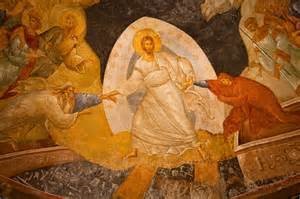
This is a carving on the front of Lincoln Cathedral. Hades is shown as a great beast, or fish, with huge jaws, holding many people. Jesus the King has forced the jaws open and tied up the devi, on whom he stands. With Peter behind him, representing the Church, Jesus pulls people out of Hades.
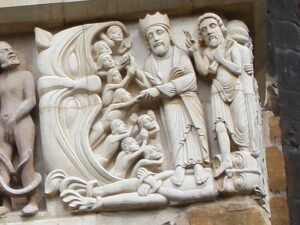
The living Scottish artist, Peter Howson, has painted this picture, called ‘Hades.’ We see many people, selfish, spiteful and suffering. Jesus is with then as the one who died on the cross, saying ‘Father, forgive them, for they don’t know what they are doing.’ Luke 23:34)
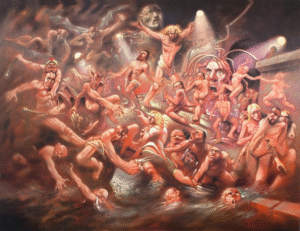
Further Material
Chapter Eight of The Lie of Hell by Roger Harper (Ladder Media Ltd. 2012)
Further exploration of the nature of Hades, particularly as darkness.
Further indications from the New Testament that Jesus uses his keys to seek and save the lost in Hades before Final Judgement.
Further confirmation from Near / In Death Experiences.
Presenting the message of Hades and Gehenna to the UK today.
Paper for the Third Rethinking Hell Conference, London 2016
Further exploration of
Hell in UK society and in the Church of England, its doctrine and prominent writers.
The history of UK teaching that eternal life is entirely granted on condition that people believe in, follow, Jesus and his forgiveness (Conditionalism.) The context of anti-Catholic debate.
How people respond to the message of Hades and Gehenna, with Jesus having the keys of Hades:
puzzlement giving way to clarity and confidence, including in evangelism, seeing more clearly the need for repentance, being disturbed, ignoring the message, not examining nor responding to it.
Why present the message of Hades and Gehenna?
to seek Biblical truth, to seek Conditionalist (Annihilationist) unity, and unity between Conditionalists, Traditionalists and Universalists, and unity between Calvinists and Arminians, and even unity between Protestants and Catholics. Also to seek the reformation of our societies, our world, through a more Jesus-based, Biblical and acceptable call to repentance.
[1] For a more detailed argument that the parable gives genuine information about Hades see: the article A Place for Torment in rethinkinghell.com
[2] Tom Wright Surprised By Hope SPCK 2011